anne-laure oberson collects curates creates [selected material]
clt-collection exh-exhibition pix-photograph txt-essai prj-project lct-lecture rsc-research
IMage-TeXt for the Bogota Declaration [pix]
The last quote [pix/txt]
IMage-TeXt [pix]
Fasciae [pix]
TAKE TWO - the mundane and the heavenly [exh]
Chère copine ... hommage à Sylvie [prj]
La fenetre ouverte [rsc/lct]
Différentes fins possibles... Marie Velardi [clt]
spam [prj]
Shoot [prj]
1971 [prj]
The transdermic zone [txt]
momas [prj]
Family story [txt]
Dessin cinématique Pierre Ferrarini [clt]
Some simple thoughts... [txt]
TheSite [exh/lct]
Site as situation [txt]
Skyline Kunihiko Katsumata [clt]
I curate, you curate, ... [txt]
D624 [exh ]
Histories of paintings [pix]
New Landscape [pix]
 
"I am currently in doubt..."
 
email me - alo AT annelaureoberson.net
 
WORK IN PROGRESS BELOW
 
_IMage-TeXt for the Bogota Declaration Project
 
Anne-Laure Oberson Bogota Declaration
 
Anne-Laure Oberson Bogota Declaration
top
Anne-Laure Oberson Bogota Declaration
 
Anne-Laure Oberson Bogota Declaration
top
Anne-Laure Oberson Bogota Declaration
 
Anne-Laure Oberson Bogota Declaration
---------------------
top
 
_The last quote - TOWARDS OUR THEORY OF MEDIA - june 16th 2009 2:23-3:28am GST+1 - Saas Fee
A project in the making with Alejo, Baruch, Rah-nee, Selcuk, Tim and me. Thanks to Geert Lovink
 
"Our 'Age of Anxiety' is, in great part, the result of trying to do today's job with yesterday's concepts."
M. mcLuhan, The medium is the MASSAGE, 1967

This was the last quote.
THAT'S IT! No more Aristotles, Heideggers, Derridas, Nancys or Zizeks to articulate the language of OUR MEDIA we will now speak our words, our images and our sounds. We are thinkers, photographers, musicians, filmmakers, programmers - artists of our time, orphans at last!
 
Anne-Laure Oberson Vilem Flusser Writings
We have been "infected with the feeling of adventure",
of course we will always quote Vilem Flusser as he is not our father but our friend.
 
Anne-Laure Oberson Our Images
This is not a redundant image.
Let's see, I am photographing the computer screen displaying a music video of Selcuk's rock band Replikas, which was censored in Turkey because a man is pointing a gun at the camera, embeded in the image is a live-feed from Istanbul of Yasemin pointing her camera towards us capturing on her screen, which is reflected in the lens, the live-feed of herself and the video projected on the wall in Saas Fee, which Tim is seen looking at.
Three actual spaces and six image planes (still counting) are collapsed in one single shot.
 
Anne-Laure Oberson Eye Am I Tim Syth
Eye am I
 
Anne-Laure Oberson Zizek
Old voices... (Tim - the beard has to go!)
 

Anne-Laure Oberson New Language Rah-nee
...new languages!

 
more images to grab
---------------------
 
 
_IMage-TeXt
top
"Our conscious phenomenal world is a cognitive construction." [Wade&Swanston]
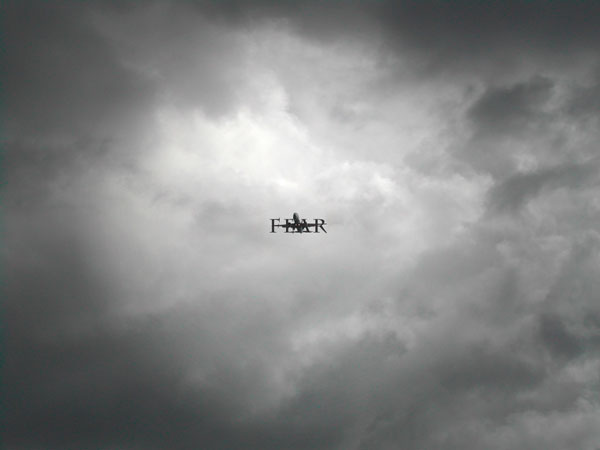
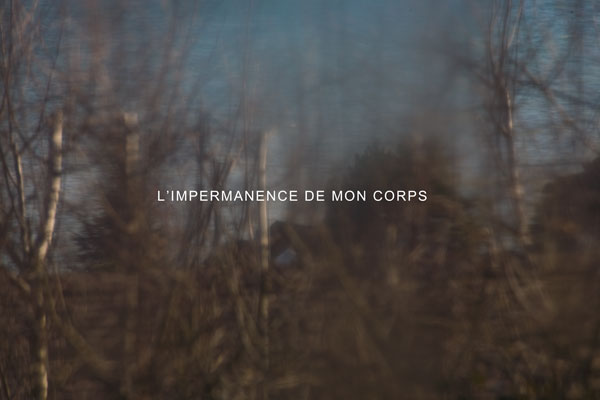
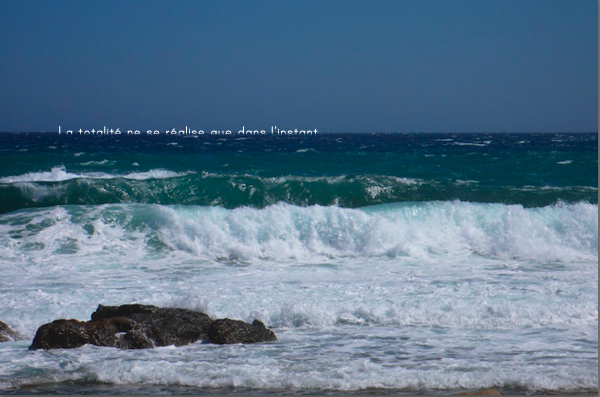
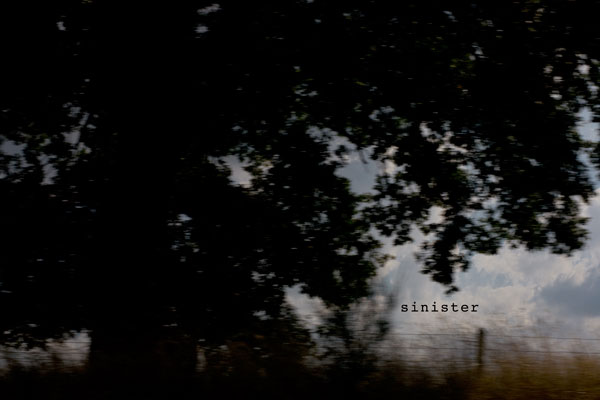
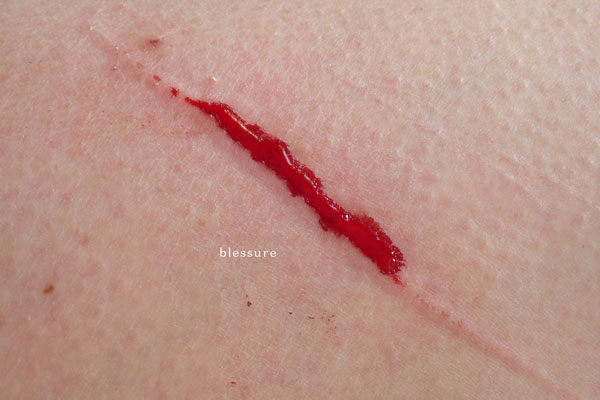
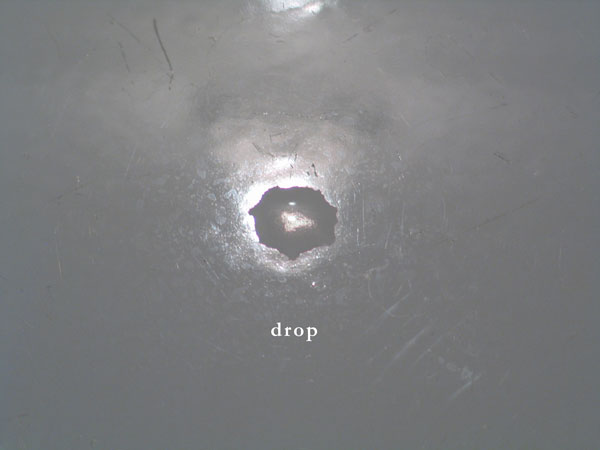
These photographs are sketches, following or concurrent to a series of readings and researches that I am currently doing for a body of work on the quantum nature of photography. Reflecting upon the nature of sight and of photography, it becomes everyday more evident that the photographic image is as much – if not more – a reality as the reality it depicts; not merely implying that a photograph is not a representation, there is plenty of evidence and writing about this. I am talking on a more phenomenological level and especially regarding to digital photography. A ccd captor functions precisely like the human eye in the way the light is captured and only thereafter analysed or rendered into an image. It is no more than a retina, the act of “seeing” being left to the processor or to the brain. The relation between words and images in the attempts below makes a voluntary direct reference to both Magritte and Ruscha and yet contradicts each of their pursuits. Here, the literal and the visual elements stand in a relation of rhetorical tautology: what you see is what you get. What it is, contrary to the symbolic double meaning of the surrealist, in whose painting La trahison des images of 1929 what you see – a pipe – is certainly not what it says it is but clearly a representation of it ('this is not a pipe', of course it is not, it is a painting, of a pipe). Contrary also to the “ready made” function of Ruscha’s words and images isolated from their context, in discrepancy, and creating a drama, achieving the right tension through incongruous relationships. The words - what we know - double the image - what we see - as it is established that our visual perception is at least as much determined by the former. Hence it is impossible to say viewing an image if we know what we see or we see what we know. By overlapping the two on the same layer in the same field of vision, they are there both at one yet exist idependently.
Thank you to Robert Irwin for the quote below. I am still learning to see.
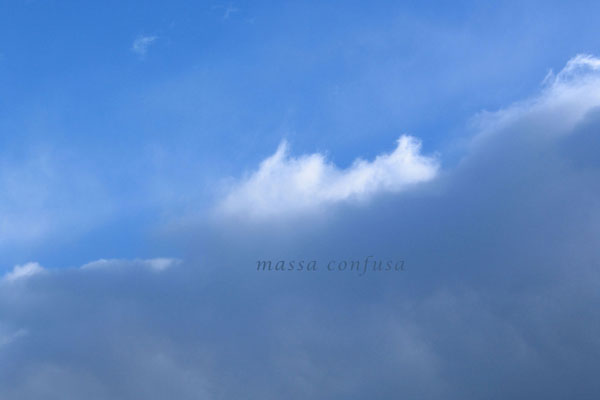
 
"SEEING IS FORGETTING THE NAME OF THE THING ONE SEES"
 
top
Anne-Laure Oberson massa confusa
top
Anne-Laure Oberson FEAR
top
Anne-Laure Oberson L'impermance de mon corps
top
Anne-Laure Oberson IMTXT
top
Anne-Laure Oberson sinister
top
Anne-Laure Oberson blessure
top
Anne-Laure Oberson PILLOW
top
Anne-Laure Oberson drop
top
Anne-Laure Oberson SUN
---------------------
 
 
_Fasciae
top
A NEW SERIES OF COLOR PHOTOGRAPHS 2008
 

Fasciae by Anne-Laure Oberson

A photographic series on the envelop, the veils of connectivity, interstitial tissues, and their (in)visibility.

In medicine, fascia is the soft tissue component of the connective tissue system that permeates the human body.
It
interpenetrates and surrounds muscles, bones, organs, nerves, blood vessels and other structures. Fascia is an uninterrupted, three-dimensional web of tissue that extends from head to toe, from front to back, from interior to exterior. It s responsible for maintaining structural integrity; for providing support and protection; and acts as a shock absorber. Fascia has an essential role in hemodynamic and biochemical processes, and provides the matrix that allows for intercellular communication. Fascia functions as the body's first line of defense against pathogenic agents and infections.

Superficial fascia is found in the subcutis in most regions of the body, blending with the reticular layer of the dermis and is found at many other locations where it fills otherwise unoccupied space.

Deep fascia is the dense fibrous connective tissue that interpenetrates and surrounds the muscles, bones, nerves and blood vessels of the body. It provides connection and communication in the form of aponeuroses, ligaments, tendons, retinacula, joint capsules, and septa. The high density of collagen fibers is what gives the deep fascia its strength and integrity. The amount of elastin fiber determines how much extensibility and resilience it will have.

Visceral fascia suspends the organs within their cavities and wraps them in layers of connective tissue membranes. Each of the organs is covered in a double layer of fascia; these layers are separated by a thin serous membrane. The outermost wall of the organ is known as the parietal layer, whereas the skin of the organ is known as the visceral layer. The organs have specialized names for their visceral fasciae. In the brain, they are known as meninges; in the heart they are known as pericardia; in the lungs, they are known as pleura; and in the abdomen, they are known as peritonea.

Fascia is a highly adaptable tissue. Due to its viscoelastic properties, superficial fascia can stretch to accommodate the deposition of adipose that accompanies both ordinary and prenatal weight gain. After pregnancy and weight loss, the superficial fascia slowly reverts to its original level of tension.

Visceral fascia is less extensible than superficial fascia. Due to its suspensory role of the organs, it needs to maintain its tone rather consistently. If it is too lax, it contributes to organ prolapse, yet if it is hypertonic, it restricts proper organ motility.

Deep fascia is also less extensible than superficial fascia. It is essentially avascular, but is richly innervated with sensory receptors that report the presence of pain (nociceptors); change in movement (proprioceptors); change in pressure and vibration (mechanoreceptors); change in the chemical milieu (chemoreceptors); and fluctuation in temperature (thermoreceptors). Deep fascia is able to respond to sensory input by contracting; by relaxing; or by adding, reducing, or changing its composition through the process of fascial remodeling.

Deep fascia can contract. What happens during the fight-or-flight response is an example of rapid fascial contraction . In response to a real or imagined threat to the organism, the body responds with a temporary increase in the stiffness of the fascia. Bolstered with tensioned fascia, people are able to perform extraordinary feats of strength and speed under emergency conditions.

(above definitions taken from http://en.wikipedia.org/wiki/Fascia)

Fasciae are found everywhere in the human body, at every level, just beneath the surface and at its deepest core, enabling rapid survival responses, protecting and permitting most vital functions to happen. They are responsible to make the body work as a whole and not just as an assembly of parts, they are the binding agent, and as such transport the information and are the depository of all the knowledge. In medicine they are credited for their malfunctions, when the visceral ones get inflammed – peritonitis, meningitis, pleurisy – or when deep ones get broken as in torn ligaments, but rarely for their fundamental and general ceaseless accomplishments, which goes unappreciated.

I believe that fasciae are present outside the human body as well, every where in the outer physical world actually. This is how the world is interconnected, through a thin veil of energy forming a tissue of information around all beings and things, from and to beings and things like a dense network of communication higways. There is no unoccupied space, fascias fill the void, there are the channels of interactions and what allows ideas to flow freely, and with causality, around and pass from matter to matter, from one side of the globe to the other. They comply to the law of energy conservation, and I would venture to say that the fasciae is where energy is stored. Since this structural system of tissue exists, it is visible, certainly not to the naked eye and physicists have or build the proper instruments to measure or model these flows. The camera is an apparatus enabled with shifting the perception of time in relation to space – it can freeze time, which the naked eye can't – therefore it allows to make representation of matter in flux. It is not a simple task to figure out how to best capture the manifestations of the existence of these fasciae. It is necessary not to point the camera directly at an object but to focus on the space surrounding the object, where the fasciae are, to photograph the space in between things, the viscosity of the air surrounding things, light and particles. To begin with, trains are a great metaphor as carriers of information, they transport through space at speed both matter and information, i.e. ideas, so this is where i am currently looking. Window panes are also intersting in the way they refocus or screen parts of the information. And extreme light conditions which forces the camera to capture uncertainty.

Below are a selection of images indicative of the direction of the search and pointing to further areas of study.

Anne-Laure Oberson fasciae

Anne-Laure Oberson fasciae

Anne-Laure Oberson fasciae

Anne-Laure Oberson fasciae

Anne-Laure Oberson fasciae

Anne-Laure Oberson fasciae

Anne-Laure Oberson fasciae

---------------------
 
 
_La fenetre ouverte [rsc/lct]
PRESENTATION AU SYMPOSIETTO DU 31 MAI 2008 A GENEVE LIRE LE PDF
 
Recherche en cours sur la representation de la conscience et la structure quantique de l'univers photographique
Quelques images de référence
brain as computerAlbrecht Durer Self-Portrait
? - conscious as machine             Albrecht Durer - conscience de soi
William BlakeLee Friedlander
William Blake - conscience divine     Lee Friedlander - alpha status

Anne-Laure Oberson Conscience
---------------------


all material copyright anne-laure oberson unless stated otherwise